Written by Nu10 / View-only demonstration
Tessaron is a simulation. Here's what happens when its can supplier fails.
Tessaron is a synthetic beverage company that Nu10 runs continuously on PIE, its process platform, to show how decisions get made and executed.
Its plants, suppliers, orders and systems are simulated; the decisions and their audit trail are real PIE runs.
Scenario figures below are labelled Simulated. They are not customer results.
The incident
A can delay puts the shipment plan at risk
A failure at Tessaron’s can supplier delays Simulated4,800 pallets of Simulated12 oz cans by Simulated14 days.
SimulatedTwo plants run Simulated2,960 pallets short — about Simulated24 million cans — putting Simulated$9.6M of shipments to Simulatedsix customers at risk.
The supplier’s recovery offer expires at Simulated5 pm the same day; a backup supplier’s rush slot closes at Simulatednoon the next day.
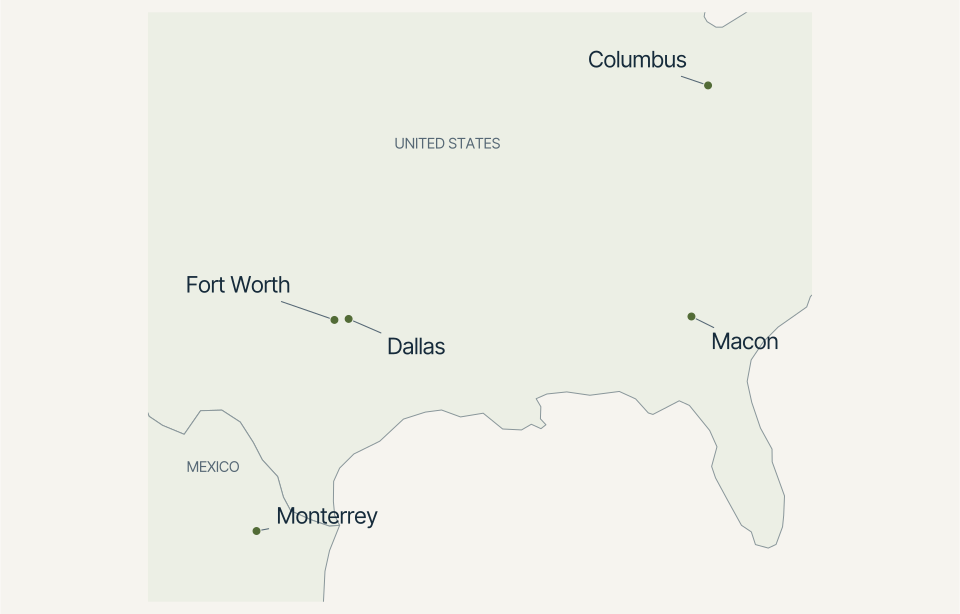
- Dallas
- Fort Worth
- Monterrey
- Macon
- Columbus
Simulated comparison
Three runs, same failure
Simulated
Do nothing
- Orders on time
- Simulated0 of 14
- Lost margin and retailer fines
- Simulated$2.49M
No recovery action
Simulated
People
SimulatedAbout 36 hours
- Orders on time
- Simulated11 of 14
- Total incident cost
- Simulated$764K
Both deadlines missed
Simulated
PIE
- Orders on time
- Simulated14 of 14
- Total incident cost
- Simulated$506K
SimulatedOne human approval
Being Simulated36 hours late costs Simulated$258K in this single incident — even assuming the team finds the best plan left.
Scenario results and context
What it adds up to
Simulated · Measured
One incident
Simulated$258K–$547K savedMeasured in the simulated incident, not a real customer engagement.
Simulated · Illustrative assumption
One year
SimulatedRoughly 1–6% of EBITDAAssumes Simulated4–8 such incidents and a Simulated10–12% EBITDA margin. This is an illustrative assumption, not a forecast.
External benchmark
Industry context
The results vary across industries, but on average, companies can expect to lose almost 45% of one year’s profits over the course of a decade.
McKinsey Global Institute, via Fortune
An external industry benchmark, not a Tessaron or PIE measurement.
Recovery through PIE
How PIE handled it
Detect the supplier notice
PIE detects the notice in the simulated supplier system.
Work out which orders are hit
PIE connects the can delay to the simulated orders and shipments at risk.
Compute the best recovery plan and check approval rules
The cheapest supplier is blocked because it is not qualified. PIE checks the feasible recovery plan against delegated approval rules.
Execute in the systems and verify arrival
PIE executes the approved changes in the simulated systems and verifies that the cans actually arrive in the simulation.
View the demonstration
Read-only viewer
Live run viewer — coming soon
A recorded walkthrough will appear here.
Illustrative calculator
Calculator coming soon
Book a guided run
Contact form coming soon. Delivery is not configured. This form is disabled and does not send or save information.